

David and Duane
Where I had a long-term relationship with two great artists.

David Hockney and Duane Michals both passed away last week. Hockney was 88 years old, Michals was 94. Both artists used images in surprising ways, and both had a profound effect on me and the work I wanted to make when I was in my twenties. I began writing this as an excuse to tell you my cute anecdote about meeting David Hockney at an airport, and to show off the page of my sketchbook with his autograph. I got carried away.
David
Once upon a time, at JFK airport, in January 1991, I met David Hockney. He was standing at the ticket counter, dealing with his luggage and, if I remember correctly, a couple of dogs. I was waiting for my flight to Paris, where I lived the year after graduating from Parsons School of Design. I’d gone to Paris to help art direct and design a magazine, but that work had finished just before I went home for Christmas. I really had no reason to go back to Paris that January. I had no job and no apartment of my own. Instead, I had a small mattress on the floor of a friend’s place in Pigalle, a few months left on my tourist visa, and about $4500 from the magazine job in the bank. I’d never had $4500 all at once in my life. I knew I needed a job and I knew I probably wasn’t going to get one there, and that going back to Paris was probably delaying reality. But I was 22 years old, and I wanted to be in Paris. I was thinking about all of this when I met David Hockney at JFK airport, in January 1991, once upon a time.
Here. I wrote about it in my sketchbook, right after it happened.
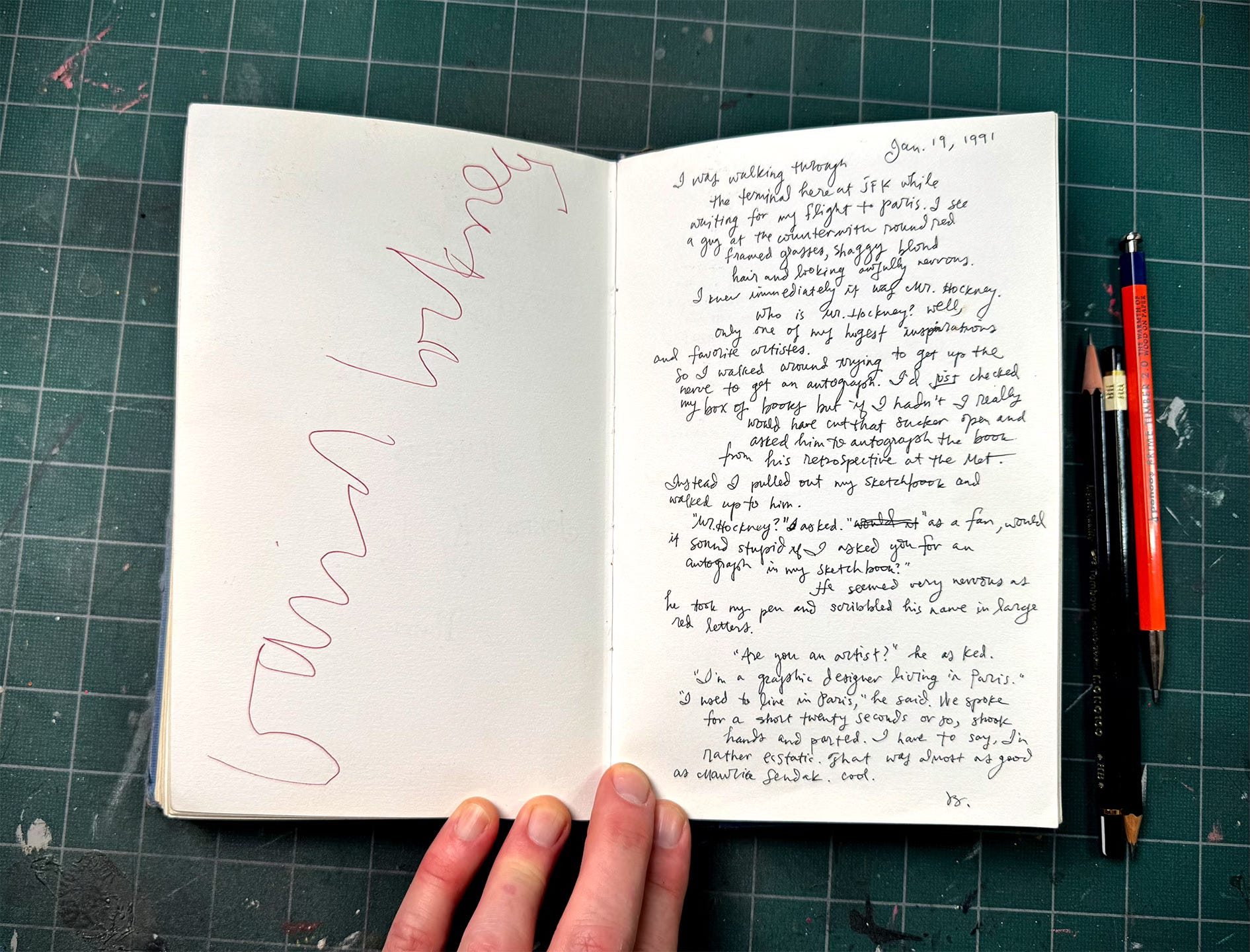
While David Hockney’s signature is barely legible, my handwriting in 1991 was nearly calligraphic (what was up with that?). I transcribed it for you anyway:
January 19, 1991
I was walking through the terminal, here at JFK while waiting for my flight to Paris. I see a guy at the counter with round red-framed glasses, shaggy blond hair and looking awfully nervous. I knew immediately it was Mr. Hockney.
Who is Mr. Hockney? Well, only one of my hugest inspirations and favorite artistes.
So I walked around trying to get up the nerve to get an autograph. I’d just checked my box of books, but if I hadn’t i really would have cut that sucker open and asked him to autograph the book from his retrospective at the Met.
Instead, I pulled out my sketchbook and walked up to him.
“Мr Hockney?” I asked. “as a fan, would it sound stupid if I asked you for an autograph in my sketchbook?” He seemed very nervous as he took my pen and scribbled his name in large red letters.
“Are you an artist?” he asked.
“I’m a graphic designer living in Paris.”
“I used to live in Paris,” he said. We spoke for a short twenty seconds or so, shook hands and parted. I have to say, I’m rather ecstatic. That was almost as good as Maurice Sendak.1 Cool.
B
Did you see that? David Hockney asked me if I was an artist.
Did you see my response? “I’m a graphic designer, living in Paris.” So, no. Not an artist, but artist-adjacent.
Which, at the time, I felt was enough. I’d only just graduated college and it seemed even too much to claim I was a graphic designer. But, how did he know to ask? Did David Hockney just somehow sense that I was carrying around a sensitive heart and curious mind?
No. David Hockney did not look at dorky 22-year-old me and say “my goodness, this young man looks like an artist!” He autographed my sketchbook. Who carries sketchbooks? Artists. It doesn’t take a detective.
Had anyone else asked if I was an artist, the answer would probably have been yes. Why not? I’d graduated from Parsons, a prestigious art school. I make things, and I draw things. I lived in Paris. Sure, I’m an artist. But no. David fucking Hockney was an artist. I was a work in progress.2
I remember when I first discovered David Hockney. It was 1985, I was seventeen years old, and I had been admitted to a four-week summer high school program at Parsons in New York City. My aunt and uncle, who were college professors in media studies and communications, gave me a book of modern art to take with me. We had art books in our house growing up, especially at my dad’s. I remember Norman Rockwell, Andrew Wyeth, Walt Disney, a book about watercolor technique. I’d spend entire afternoons lying on the sofa, paging through these books and reading about how the images were made. We didn’t have much exposure to anything modern. Warhol was there, of course, but he was more of a celebrity, and his work was on posters and coffee cups. I didn’t associate him at the time with “art.” We didn’t really go to art museums, and even if we had, I’m sure no one in my family knew enough about any of it to appreciate what Diebenkorn was trying to accomplish with his Ocean Park series, or why Cy Twombly’s scribblings were important. If anything, modern art was something we kind of joked about. “My kid could have painted this.” But I knew that there was more to it than that. If it were the case that your kid could do that, then why is that in the museum, and this is on your refrigerator? Even as a teenager, I knew enough to know that I didn’t know shit.
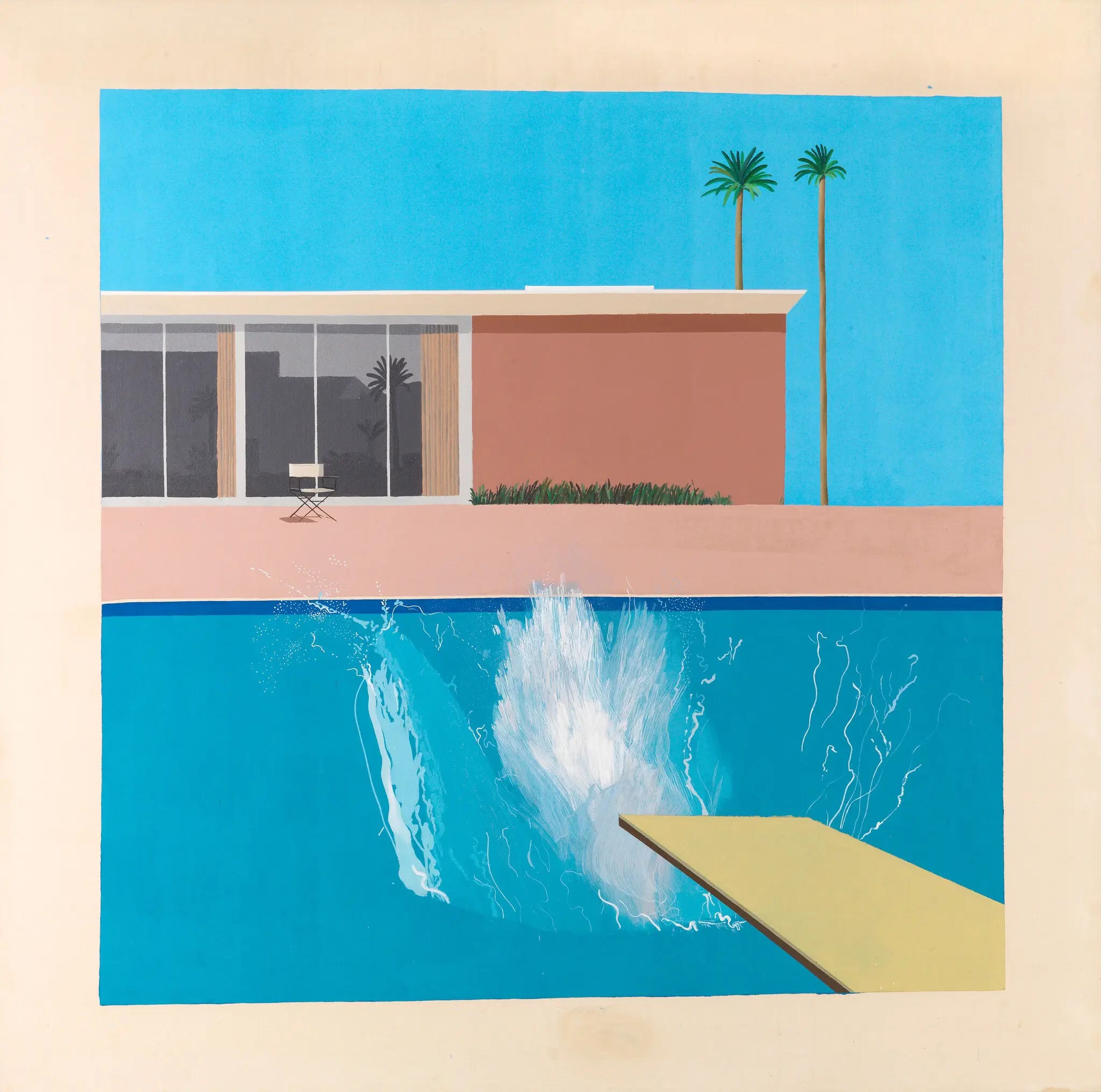
The artists in this book were the usual modern suspects: Jackson Pollock, Frank Stella, and, yes, Warhol. I didn’t understand most of what I was seeing, especially the Francis Bacon, but I remember stopping on A Bigger Splash, Hockney’s 1967 painting of a Los Angeles swimming pool. I loved it immediately. The flat colors and shapes. The angles. And in the middle of it, that splash.
I knew that there was something more going on here as well. I’d seen photographs, like those of Cartier-Bresson, where the image captures a singular moment in time. But paintings weren’t supposed to be like that. Paintings were still lifes, and landscapes. A painter sits down and paints, but it takes hours, or days. They weren’t really supposed to depict a decisive moment. But this painting did. How long did it take him to paint that splash, those marks, those tiny dots representing thousands of drops of water? Did he freeze time? Or paint from photos? I knew he’d broken some rule. I didn’t know what that rule was, because I didn’t know shit. But I loved that painting.
That summer in New York, my class visited MoMA, where my instructor herded us through a Kurt Schwitters exhibit. An actual twinkle in his eye, he asked me what I thought. I replied that it just looks like torn up pieces of paper. He laughed, “It is torn up pieces of paper! So why is it at the Museum of Modern Art?” It wasn’t really a question, it was a challenge. He knew I was curious. He knew that given time I’d figure it out. He knew what I knew. He knew I didn’t know shit.3

Three years after that trip to New York, I got to see that painting in person. It was summer 1988 now, I was a sophomore at Parsons, and I was waiting tables at The Boathouse Cafe in Central Park. The Metropolitan Museum of Art had staged a huge retrospective of Hockney’s work. I must have gone to that show seven times that summer, and each time I’d beeline to A Bigger Splash, getting as close as I could to the canvas, and those brush strokes, that splash.
There was no internet in 1988, so this retrospective was the first time I’d seen most of Hockney’s work in any form. His paintings, his colored pencil drawings, his etchings, his photographs and collages. Realistic and naturalistic portraits of his mother and friends next to sprawling abstractions of southern California landscapes, alongside grids of Polaroid photos. Those photo-collages had the biggest effect on me then. While Hockney froze time with a painting, like in A Bigger Splash, he extended time with photos, using these moments to tell a different story than could be told with only a single image. You see the passage of time: a diver jumping into a pool. People reacting during a game of Scrabble. It was amazing.
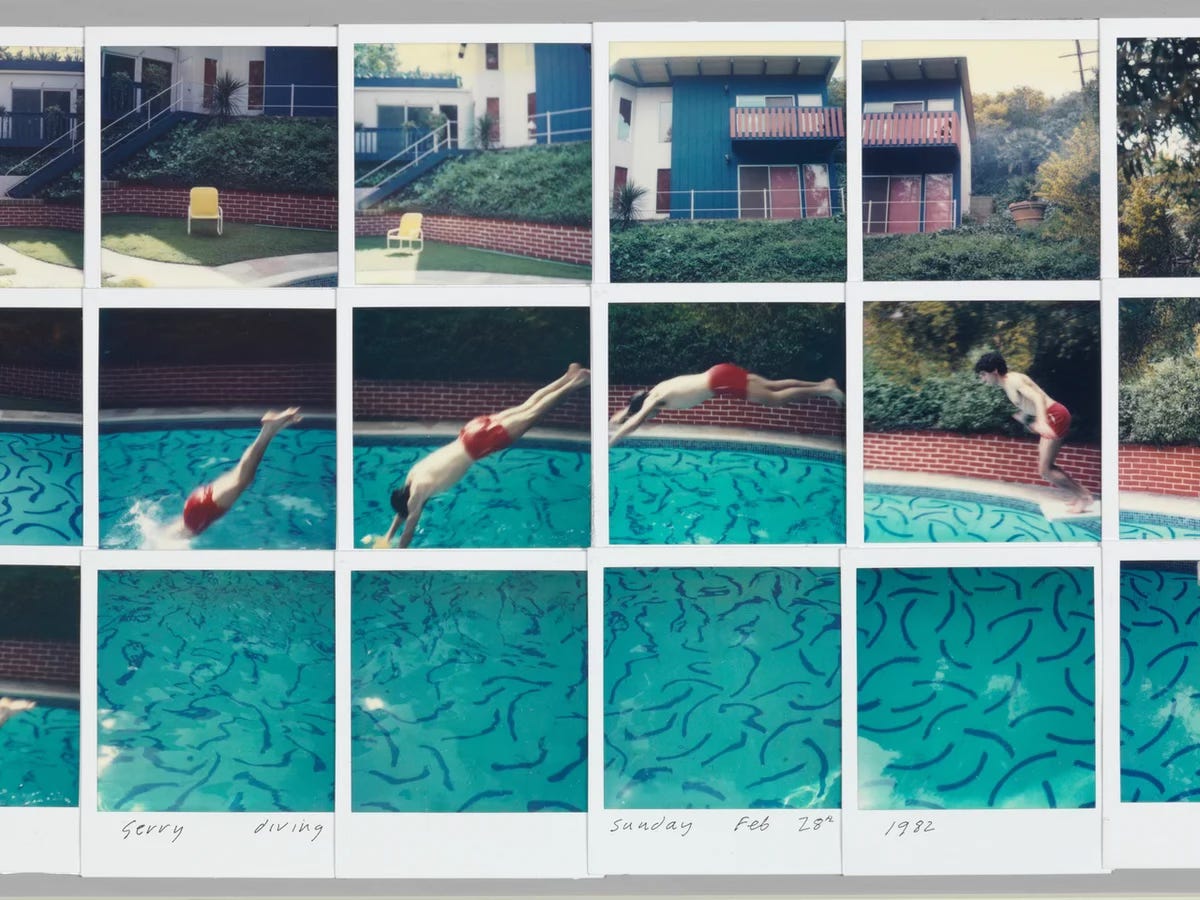
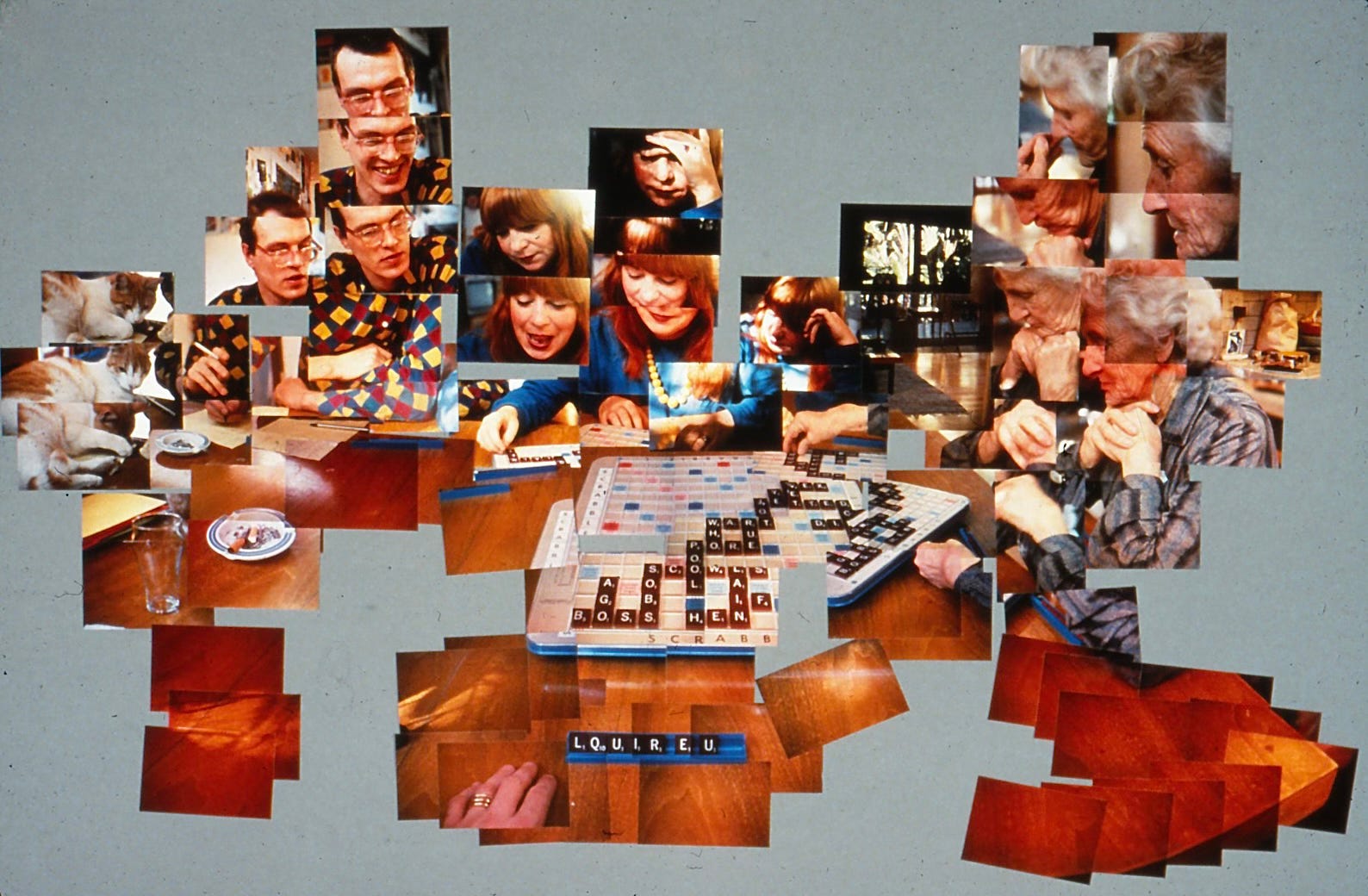
I didn’t know what to make of this. But I knew that now I knew even less than I did before. Hockney’s work asked questions I didn’t know how to answer. I didn’t know shit before, and now I knew that I knew even less.
David Hockney did that to me.
Are you an artist?
Duane
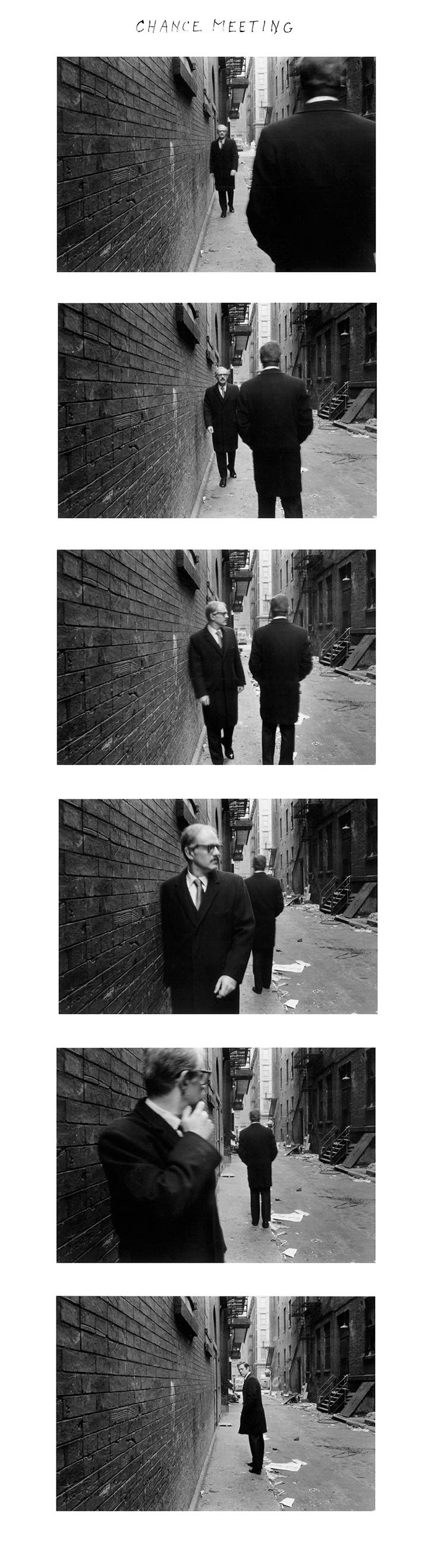
I never met Duane Michals, and my experience with his work wasn’t quite as deep as it was with Hockney. In fact, without Hockney, I’m not sure I’d have known what to make of Michals. But it was still profound. While Hockney shifted what I knew about the use of time and materials, Michals brought in storytelling, sequence, and text. The juxtaposition of images with images, telling a story over time; and images and words, and the way the two can play with each other, and contradict each other, has been paramount in everything I do as long as I can remember.
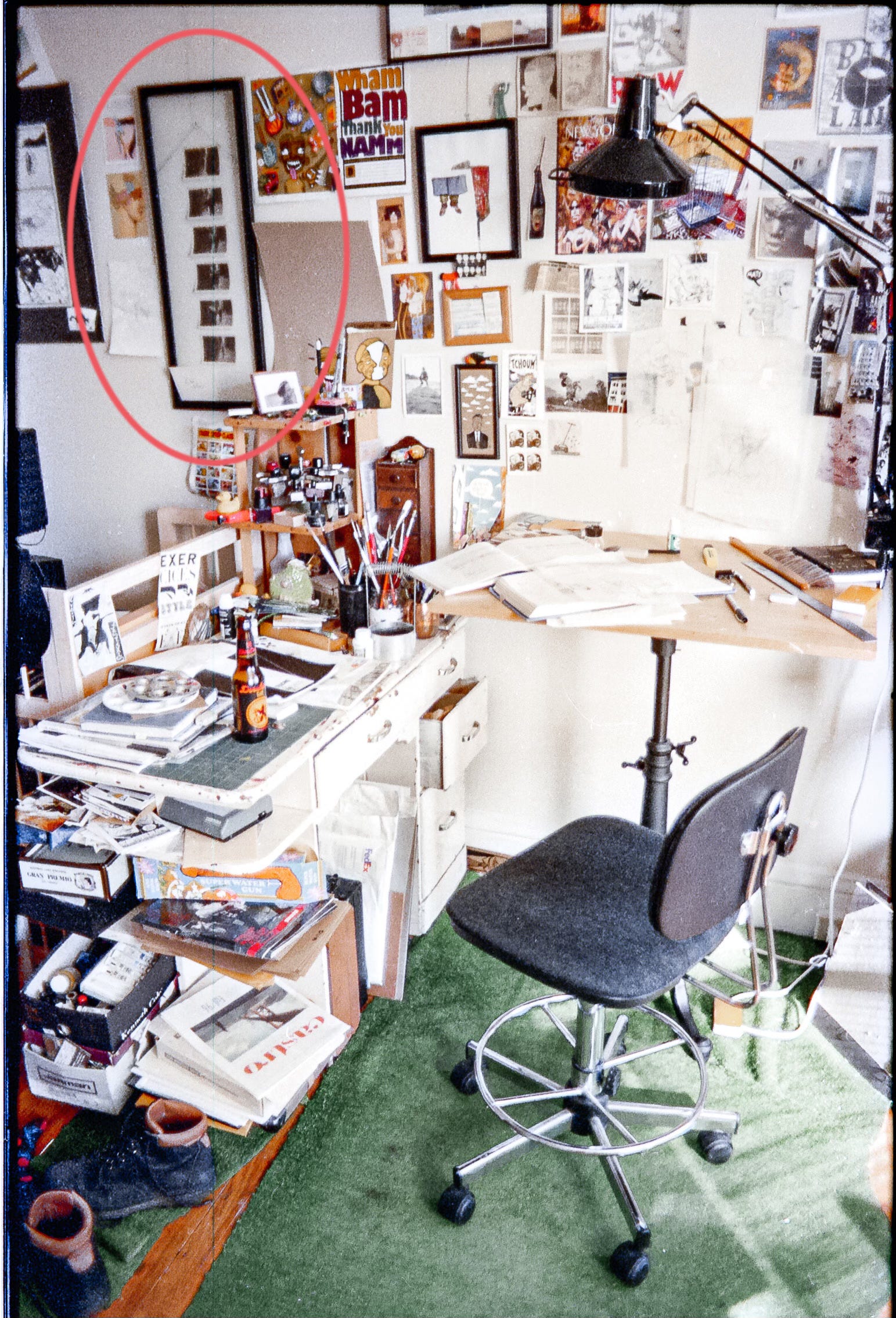
Where Hockney allowed time to pass in his photographs and paintings in a more haphazard way, usually allowing the viewer to meander and take it in, like the buzz of conversation, Michals wanted you to read his work in order. He was telling you something. This, then this, and now that. I was making graphic novels and animating things and planning films when I found Duane Michals, and his sequential work stayed with me. I have a photograph I took back then of my drawing table, in 1997, and you can see his Chance Meeting framed on the wall of my apartment.
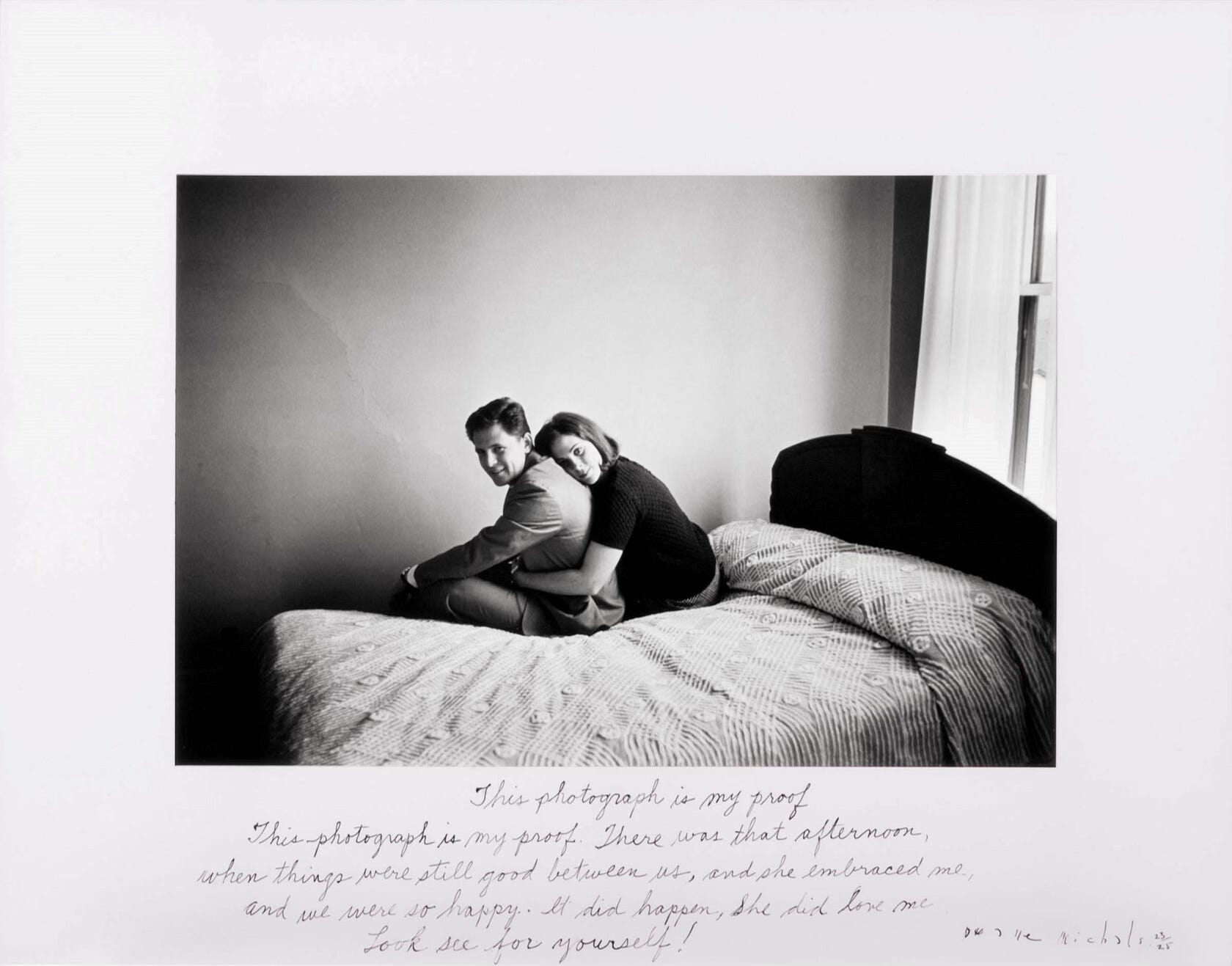
Of course, Michals is best known for his photos accompanied with text. I’m pretty sure the first Duane Michals’ photograph I saw was This Photograph is my Proof (1967). It’s a perfectly fine picture, black and white, two people, obviously fond of each other, sitting on a bed, looking at the camera, like a snapshot. But the text. That story. It broke my heart.
I used to collect old photos, and I still have boxes of them that I occasionally pick through for my collages or drawings. Sometimes I find one, maybe of a soldier, or a toddler, or a middle aged couple. Visually, these pictures are old and faded, and inherently interesting to look at. A few of them have text written on the margins, or the back of the photo. Lovely, perfect, old-fashioned handwriting:
“Bobby, 1942, killed in Okinawa.”
“Margaret, my sister, died of pneumonia.”
“John and Mary-Ann, 1974. Divorced later that year.”
But Bobby and Margaret were alive when the photos were taken. John and Mary-Ann, they were in love once. These photos are proof.
But was this photo actually proof? Was the story real? Yes and no. Critics of Michals’ work complain that his photo-stories are “fake,” that this photo of this couple was staged, and the heart-breaking sentences were made up. But it didn’t make it any less real or interesting to me. If anything, it showed me the power of storytelling. Much like, but different from, Hockney’s photos, it belied the objective truth supposedly inherent in photography. Like one can do with a painting, or a typewriter, it told a story that Michals wanted to tell. The thing didn’t have to have happened just like that. Does it resonate even though it’s a fiction? Of course it does. Are all films documentaries? Of course not. Take a photo. It’s fine. Add text. It kills me.
When I discovered Michals, in 1996, I’d just broken up with my first real girlfriend. We’d lived together, we’d traveled together, and I had envelopes full of photos that we’d taken of our trips to Spain and France, and Yosemite, and in our apartment in San Francisco. In the pictures we were happy, and smiling, and we seemed glad to be together. The total opposite of the way things seemed as it all fell apart, the way I remembered it. I remember wishing that I had photos of that dinner in Barcelona where we were not speaking to each other, and pictures of the argument we had in the tiny hotel room in Toledo. Not just the perfect shot taken one evening while walking along the Seine. After we broke up, all I could recall was the sadness, but these photos were my proof.
Duane Michals did this to me.
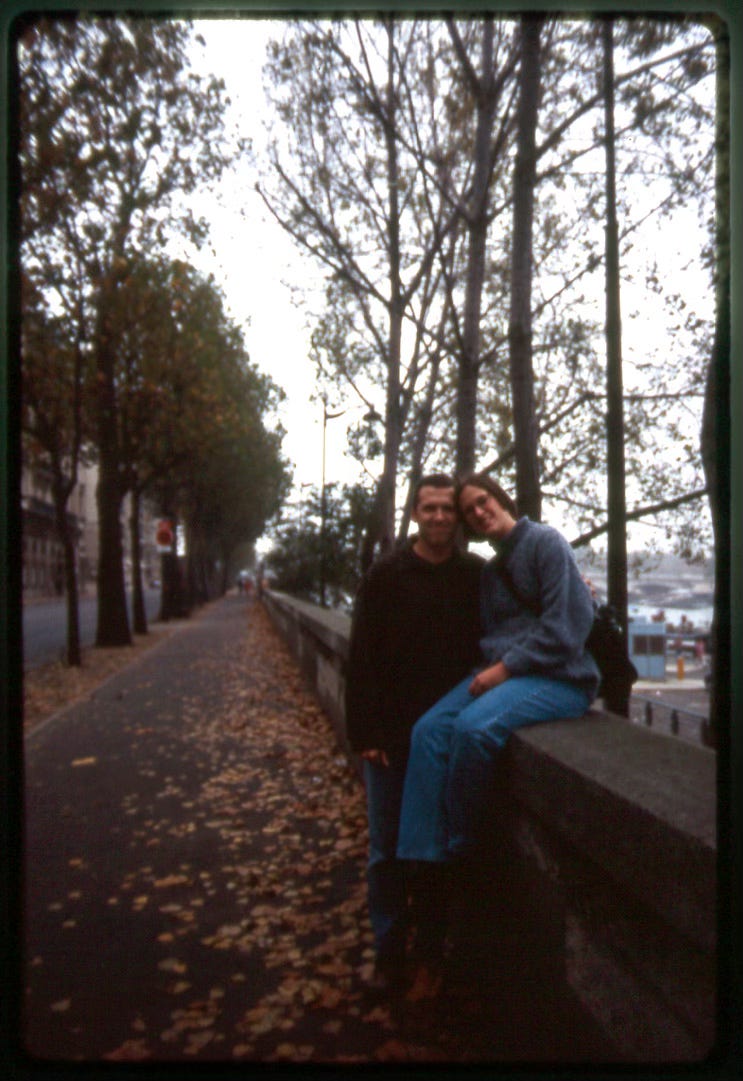
A coda: I should mention that I am perfectly aware that so much of Hockney’s and Michals’ work involves themes and ideas that, at the time, were either lost on me or didn’t matter to me. In 1996, I saw Chance Meeting as a fascinating sequence of images that influenced my comics. I had no idea it was a coded depiction of gay desire. Obviously, I knew that Hockney’s paintings of nude men in swimming pools were more than just pretty paintings of the South of France and Los Angeles landscapes. As a straight man in his late 50’s with two queer children, it’s often been interesting to me that nearly all of my biggest inspirations and influences were artists of a particular generation, who were gay men, and often wrote coded stories and created images with secrets. Edward Gorey, Maurice Sendak, Arnold Lobel, Michals, Hockney. Maybe there’s something to consider here. Maybe there’s some underlying thing about nostalgia, curiosity and imagination, and being an artist and storyteller. Or maybe it’s just coincidence. What do I know?4

Things have ramped up these last two weeks with several of my writing projects, including my graphic novel project, The Walk. I posted an entry to the paid tier of this blog last week about The Walk and the themes and ideas I’ve been working through with the story. I’m writing another now about some bigger science fiction ideas, and how I’m hoping to use them in this story. There’s not a lot to show yet as far as new drawings, but that’ll come. Consider upgrading your subscription and supporting this project.
Thanks.
I met Maurice Sendak while waiting tables in Central Park. he was a customer, and I kept his signed American Express check, which is framed on my studio wall. This is another Substack story for another Substack day. Maurice Sendak tipped well.
The question of who is an artist, and whether I was one, or would be one someday, was on my mind at the time. I wanted to design. And illustrate. And photograph. And make films, and write, and make prints. I was ambitious and I was in a hurry. I wondered if graphic design was going to be just a job, or was it an art? I wanted to do something important. Something big. I could do a lot of things, but I didn’t think I had much to say. I was worried I’d always rely on other people’s messages and ideas. I could play the instrument, but I needed a composer. Maybe it was coincidence that I began writing my first graphic novel, Frederick & Eloise, a month after returning to Paris. Maybe not.
I love Kurt Schwitters. I recently found the catalog for that 1985 Schwitters show at MoMA and bought it without hesitation.
I don’t know shit.
Love all of this! Can’t wait for the Sendak story, too.
Delightful memoir...and how cool to have Hockney's autograph in your sketchbook! Most artists will probably never know how much they have influenced us in small or profound ways.